Promoting Safety

Promoting Health and Safety
Our number one priority is the safety of our employees, contractors, business partners, customers and communities. To continually reinforce a strong culture of safety and high performance expectations, we use a combination of management systems, best practice-based operational standards, and documented work processes and programs.
Our Occupational Medicine team provides routine medical testing for job-related exposures, injury management, and case management for all types of leave. Employees are supported by a network of licensed healthcare professionals embedded within every organization, ensuring consistent support and care.
MPC's Industrial Hygiene Standards are designed to identify and address employee exposures to chemical, physical, biological and other hazards. We achieve this through elimination, engineering controls, work practice controls, personal protective equipment and monitoring. Our Health, Environment, Safety and Security policies and standards encompass health programs that address all aspects of these hazards, creating a safe and healthy work environment for everyone.


Life Critical Expectations
Our greatest focus is protecting and preserving the well-being of our great people. Our goal is an incident-free, injury-free workplace. We want everyone who comes to our sites to return home safely at the end of the workday. We are committed to creating a safe environment and work diligently to prevent incidents and injuries throughout all operations. We focus on continually improving our safety management systems and compliance programs by engaging our employee and contractor workforce via training, behavior-based safety programs, contractor safety councils, and sharing best practices and lessons learned.
We have developed a Life Critical Expectations document that outlines the company’s expectations for its employees and contractors to work safely.
OSHA Voluntary Protection Program (VPP)
The Occupational Safety and Health Administration’s (OSHA) Voluntary Protection Program (VPP) acknowledges employers and workers in private industry and federal agencies that have implemented effective safety and health management systems. Companies and facilities that achieve VPP status boast injury rates significantly lower than the Bureau of Labor Statistics averages for their respective industries.
VPP exemplifies a cooperative effort between regulators and industry driving higher-level safety performance at all levels of an organization. To achieve VPP status, applicants must complete a rigorous application and inspection process by OSHA that can take multiple years.
There are three levels of designation: Demonstration, Merit, and Star status, which is the highest level. Each level represents a commitment to maintaining and continuously improving workplace safety and health standards.
Working closely with regulators, such as OSHA, enables us all to foster a safer workplace. Currently we have earned 41 VPP Star certifications covering 54 MPC and MPLX facilities. In 2024, our Garyville refinery celebrated 30 years of maintaining its OSHA VPP Star status, making it the longest-running VPP Star refinery in the U.S. The recognition acknowledges exceptional safety practices and highlights the refinery’s commitment to a safe work environment.

Personal Safety Performance
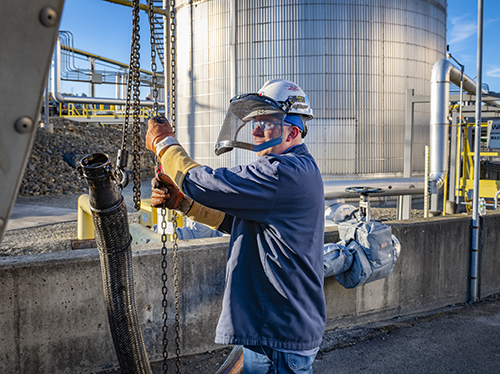
Consistent with our core values, we approach our work with the highest commitment to safety. To continually reinforce these values and drive strong performance, we use a combination of best practice-based operational standards, documented work processes, proven management systems and behavior-based programs designed to train, protect and empower our employees and contractors. If any employee or contractor believes a task is being performed unsafely, they have the authority and obligation to stop the work in progress until the safety concern is addressed — no matter how big or small the job may be.
Process Safety
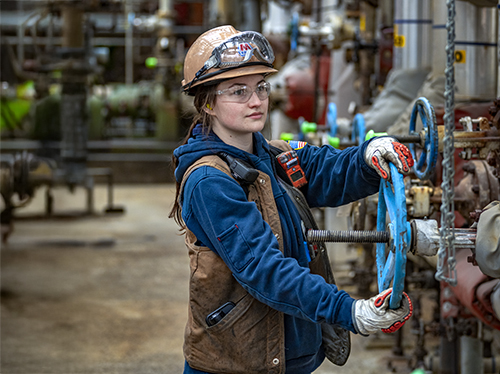
In simplest terms, process safety ensures that our pipes, tanks, processing units, valves and other hardware all work as intended to keep hazardous materials contained. We proactively manage our process safety risks by continuously improving our process safety management systems such as mechanical integrity program, management of change, safe work practices, operating procedures. Additionally, we maintain a rigorous process safety risk assessment process to identify risks and implement the appropriate safeguards including alarms, automated shutoff systems, relief devices.
MPC tracks process safety incidents consistent with the American Petroleum Institute’s (API’s) Recommended Practices 754, which outlines process safety performance indicators for the refining and petrochemical industries. This practice incorporates both lagging and leading process safety metrics to better gauge a company’s performance. The data highlights areas of focus for risk mitigation.
Process safety event Tier 1 and Tier 2 rates are calculated per 200,000 worker exposure hours, encompassing both employees and contractors. This method aligns with the calculation basis for OSHA occupational injury/illness rates. Additionally, a process safety score is a severity-based metric calculated using the number of Tier 1 and Tier 2 Process Safety Events (PSEs).
We track and report our process safety metrics to show accountability to employees and all our stakeholders. We want you to stay informed about our performance and progress and results can be found in the performance data tables within our annual Sustainability Report.
Emergency Preparedness
Our commitment to robust preparedness ensures that we can respond effectively should an emergency event occur. By consistently investing in our response capabilities, we are equipped to mitigate and manage the impacts to the environment and people. Each of our operating locations has dedicated emergency response teams and site-specific emergency preparedness and response plans tailored to the risks they may face. These plans undergo regular drills to test proper execution in the event of an actual incident.
MPC’s Emergency Preparedness Group (EPG) oversees our response program, including companywide guidelines and procedures on how to prepare for and respond to emergencies. The group’s focus is to continuously strengthen our incident response capabilities. The EPG staff coordinates with business components to share best practices and resources across the company.
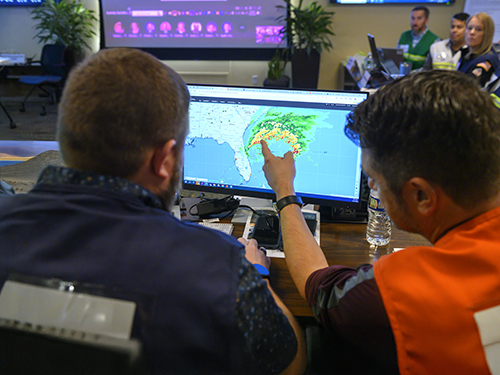
The EPG staff facilitates meetings of a cross-organizational team called the Hurricane Advisory Committee (HAC), which monitors storms throughout the hurricane season. The HAC makes certain the appropriate groups have the latest weather updates and communicate effectively before storms make landfall. Learn more about how MPC incorporates extreme weather planning into its emergency preparedness and response program.
Additionally, for emergency events that may require resources beyond those available at a local facility, our EPG maintains a Corporate Emergency Response Team (CERT) with response expertise and training in the Incident Command System (ICS), should an emergency event occur.
Learn More